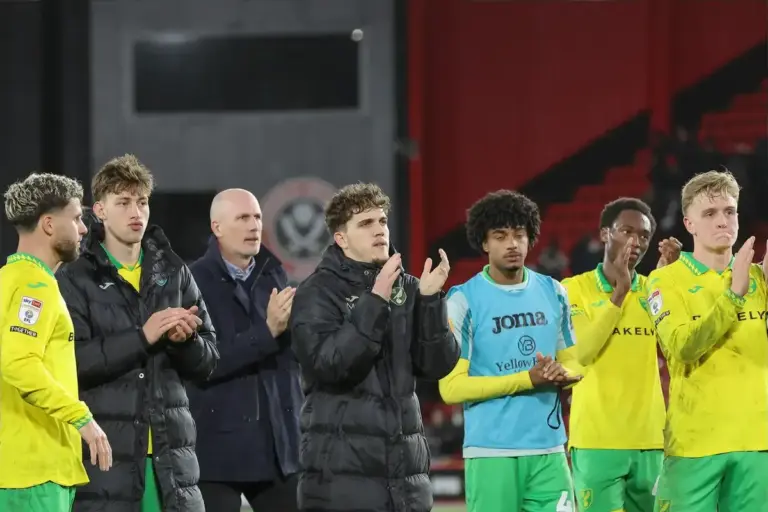

Norwich City’s latest season-ticket sell-out is not just a soft-focus loyalty story. It is a hard commercial signal at a club trying to turn renewed belief under Philippe Clement into a more durable football operation.
The club confirmed that general admission season tickets have sold out ahead of the 2026/27 campaign, extending the familiar Carrow Road pattern: demand remains stronger than the building that contains it.
That matters because Norwich are no longer talking about stadium development in the abstract. The club’s phased Carrow Road plans, first presented as a supporter-experience project with a new fan zone and longer-term stadium modernisation, have already run into the most difficult issue in football infrastructure: asking loyal match-going supporters to absorb disruption.
Demand Changes The Pressure On Norwich
A sold-out season-ticket allocation gives Norwich two realities at once. The first is positive: there is a committed base prepared to back Clement before a ball is kicked. That makes a difference in a Championship promotion race where home form, atmosphere and momentum can quickly become self-reinforcing.
The second is more complicated. When demand is capped, every seat becomes political. Any redevelopment plan that moves people, alters away-fan positioning or changes the balance between ordinary seating and premium inventory will be judged against the fact that supporters are already filling the ground.
That is why this announcement lands differently from a routine ticketing update. It strengthens the argument for growth, but it also raises the standard for consultation. Norwich cannot credibly say there is no capacity pressure; equally, they cannot treat that pressure as permission to reshape Carrow Road without emotional precision.
ReadNorwich has already examined the broader stadium dilemma in the reality of a 35,000-seater Carrow Road. The new sell-out simply drags that discussion back into the present.
Clement’s Rebuild Needs A Full Ground, Not A Fractured One
For Clement, the importance is immediate. Norwich’s football rebuild has been framed around sharper recruitment, improved standards and a clearer identity after a turbulent period. The early summer has already brought aggressive movement in the market, but the manager also needs Carrow Road to feel united again.
That is the central tension for the board. Stadium expansion can look like ambition on a spreadsheet. On a matchday, however, ambition is measured by whether the people who have built routines around the same seat, same entrance and same community feel respected by the process.
The club’s ownership and executive team should treat this sell-out as leverage, not as a victory lap. It proves there is appetite for Norwich to grow. It also proves the existing support is valuable enough to protect carefully.
If Clement’s side start quickly, the demand curve will only steepen. More supporters will want access, more commercial pressure will follow and the capacity debate will become louder. That makes the next stage of Carrow Road planning one of the club’s most sensitive off-pitch calls.
Norwich have the backing. The challenge now is to turn that backing into growth without making the supporters who guarantee it feel like obstacles to progress.
That balance will define the next stage. If the club communicate early, protect the matchday habits that matter and separate necessary modernisation from avoidable displacement, the sell-out becomes evidence for ambition. If they misread the mood, the same demand becomes a warning that loyalty cannot be treated as an unlimited resource.
The next consultation therefore needs to be as detailed as any transfer plan. Supporters will want to know which seats are affected, why any movement is unavoidable, how pricing will be protected and whether improved facilities are being built for the wider fan base rather than a narrow premium audience. Those answers will decide whether Carrow Road expansion feels like collective progress or another pressure point.