
There’s no doubt last season was a low point. And I would prefer not to churn up any memories, but, if we’re not careful, the same faults will go untended and I don’t think any of us want a second helping of that.
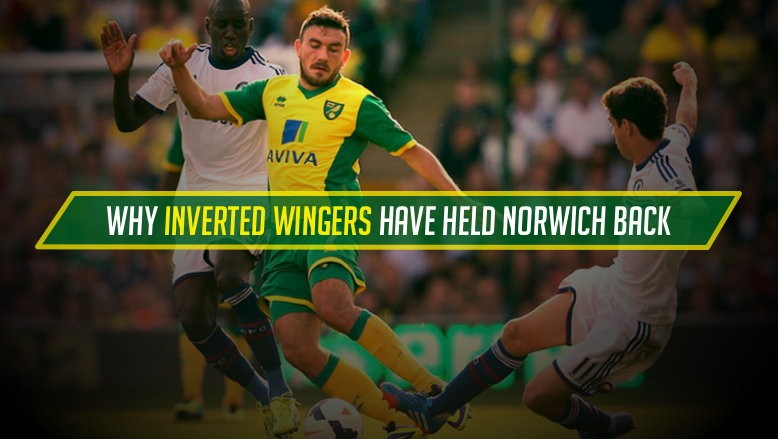
Hughton’s stubbornness resulted in the persistent use of inverted wingers over his deplorable reign as Norwich City manager. My worry is that Adams will stick with such a strategy and once again see no benefit. He refrained from changing it when he took over as interim manager towards the end of the season, so the question is: will he continue and starve the strike force just like his predecessor?
If you don’t know what I mean by the term ‘inverted wingers’, then let me enlighten you. It is where a player operates on the opposite side to their strongest foot – i.e. a right footed player who plays on the left. Yes – almost immediately it seems unnatural. Snodgrass, Pilkington, Gutierrez and Redmond all fell victim to this positional strategy, and I feel that it not only held their own games back, but was a contributing factor in the demise of Norwich City. Here’s the thing; for an opposing defender, it is far easier to deal with inverted wingers, as the play is always in front of them. As soon as one of our wingers cut inside, the defender only has to jockey them, before the ball inevitably goes backwards and the attack has to start again. Any crosses which do come into the box are often less dangerous as the ball is not directly in front of an attacker’s body. Therefore more adjustment has to occur to get a shot on target, and in a crowded penalty box this can prove to be difficult.
Of the 20 goals which we scored from crosses over the last two seasons (Premier League), an astounding 15 have come from direct wing play, as opposed to inverted. Unanimous it seems, natural wing play is the way forward. Redmond’s pace and skill is unparalleled by many of the division’s midfielders, and if Adams restricts him to the right midfield position means he can focus on what he’s good at: scaring the full back, reaching the byline, and delivering a ball into the box. I admit – he seriously needs to work on that last part. However, it is so frustrating to see Redmond, or any other player for that matter, cut inside and have a shot when: a) there are far better options available, and b) they can’t actually shoot!
From natural wing play, crosses don’t have to reach the same standard of quality. One could scuff a delivery across the 6-yard box and it would still be as dangerous – a winger who cuts back doesn’t have this same margin for error.
While the strikers failed to find the net last season, more pressure was put on the rest of the team to score goals. Seventeen successful strikes came from the midfield (60%); the introduction of Fer fruitfully contributed to that tally.
But it’s a paradoxical situation.
Play with players on their natural sides, and they can put better balls in, so the strikers score more often. Then, there is less pressure on midfielders to score goals, and so less chances are dismally wasted when inept wingers cut inside and shoot. Perhaps the difference last season was individual players’ performances. Although it seems that there isn’t a huge contrast between last season and the one which preceded it, players such as Snodgrass who were notably off cue. 39% of our goals came from set pieces over the 2012/2013 period, far more than last season (17%) which in itself proves his delivery was falling short. Then again we shouldn’t be relying on set plays to score goals, should we?
Away from home, I understand that we aren’t always going to be all-out attacking (especially not in the Prem), which makes counter attacking so much more important. For this you need pace and power. We have both, if used correctly, but inverted wingers seems to seriously limit the urgency of our attacks. In fact, I think Snodgrass often forgot we were attacking, after he had dithered about with it on the wing while turning a blind eye to the intelligent runs and developments which materialised around him.
There are still some benefits to the tactic, though, otherwise why would any team employ it? Often, it can allow a side to congest the midfield as the wide players are drawn in, and this can be an advantage against technical teams who enjoy space. Moreover, it allows the midfielders to get shots away, but as I said before, too often they are high and wide. It is therefore quite dependent on the selection of players. Not no-pace Snodgrass, who stops, shimmies, faints, dummies, and loses the ball. Although the Murphy brothers and Redmond have an inherent hunger to drive forwards, it is still not clear whether it would be a success at this stage in their development.
Therefore, when Adams picks up the pieces that Hughton left scattered upon the dressing room floor, will he create the same artwork, or craft his own portrayal? Will he stick with this tactic, and fall into the jaws of despair once more, or use the players we have effectively and make it work?








Comments.
Loading comments…